
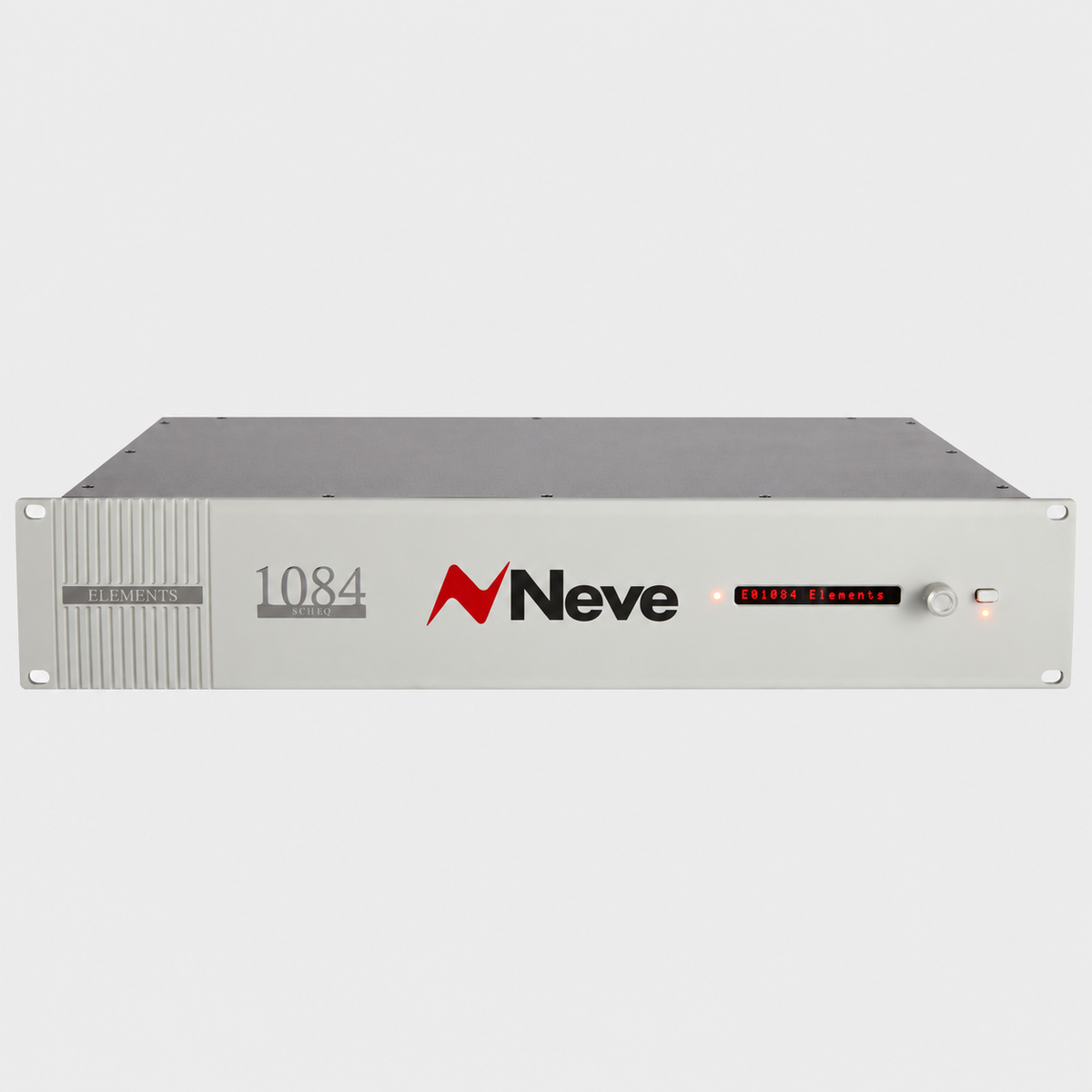
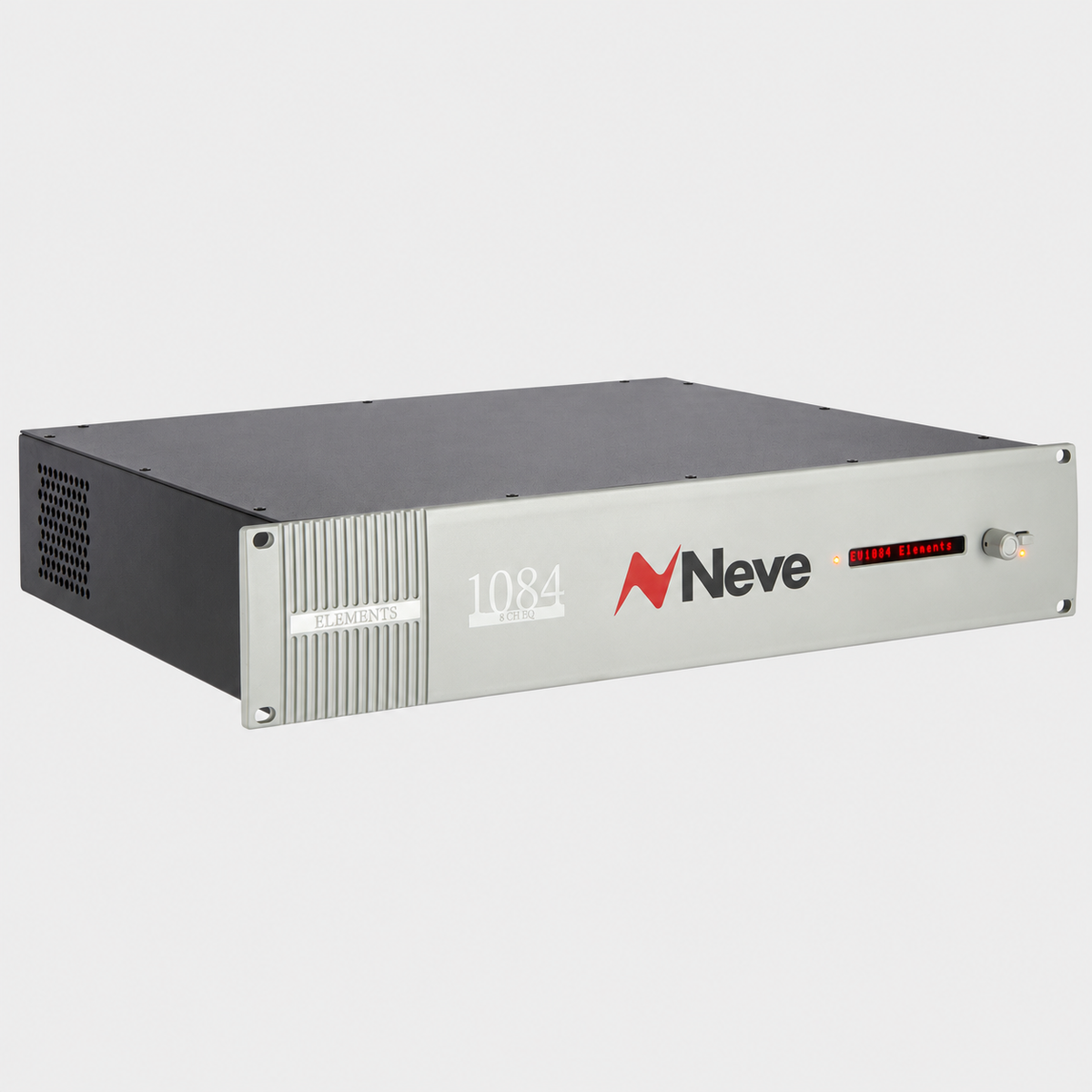


NEVE ELEMENTS / 1084 EQ
Bring a classic voice
into your next record.
Eight channels of authentic Neve 1084 inductor EQ, pairing classic tonal shaping with DAW control, recall and automation.

CLASSIC INDUCTOR EQ. A NEW WAY TO WORK.
1084 EQ. In your element.
The Neve Elements 1084 EQ puts eight channels of classic Neve inductor-based equalisation into a standalone 2U processor. It draws on the 1084 circuitry associated with the sound of Neve’s legendary Sound City 8028 console, bringing that approach to tonal shaping into a contemporary studio workflow.
Choose a frequency, turn towards the sound you hear in your head and listen to the part settle into the record. With real analogue circuitry under software control, Elements lets you work with the character of hardware while keeping settings, revisions and automation within reach of the session.

THE ANALOGUE ENGINE
Three bands with a strong point of view.
The low-frequency shelf offers 35, 60, 110 and 220 Hz positions with ±16 dB of adjustment. At the other end of the spectrum, the high-frequency shelf offers 10, 12 and 16 kHz, also with ±16 dB. These are direct, purposeful choices for shaping weight and brightness by ear.
The mid band provides six centre frequencies from 360 Hz to 7.2 kHz, a switchable High Q response and ±12 dB or ±18 dB of peaking adjustment. Move from broader tonal work to a more focused intervention without losing the immediacy of the classic 1084 control approach.
KNOW YOUR CONTROLS
Choose your next move.
35, 60, 110 or 220 Hz; ±16 dB. Choose the foundation of the sound.
360 / 700 Hz and 1.6 / 3.2 / 4.8 / 7.2 kHz; switchable High Q.
±16 dB. Choose the upper shelf that best suits the source and arrangement.
Selectable high-pass and low-pass filters help define the useful bandwidth.
EIGHT CHANNELS, ONE CREATIVE WORKFLOW
Find the weight. Shape the edges.
The 1084’s filters are as useful as its three EQ bands. The high-pass filter offers 50, 80, 160 and 300 Hz positions, while the low-pass filter offers 6, 8, 10 and 18 kHz. Both use an 18 dB-per-octave slope, giving you practical ways to manage the extremes of a source before judging its place in the mix.
Try the low shelf to build a firmer foundation, the mid band to bring a part into focus and the upper shelf to explore a brighter balance. With eight channels available, this can become the way you shape several key parts of a production rather than an effect reserved for a single source. Save the settings, compare a new direction and return to the one that serves the record.
HARDWARE SOUND. SESSION RECALL.
Keep the sound.
Keep the settings.
The Element Control Plugin puts control of the analogue hardware inside the DAW. Settings are recalled with the session, and automation lets the processing follow the music. AAX, AU and VST3 formats support integration with a wide range of DAW environments, while the standalone Neve Elements application offers control on Windows and macOS.
That matters when a mix returns for another revision, or when several projects share the same rack. You can return to the processor settings associated with the session and continue working from there. The sound is produced by the physical Neve circuitry; the plug-in is the control surface for that hardware.

Explore a change. Find your way back.
Stored snapshots and a 64-step undo system give you useful ways to revisit a decision. Capture a starting point, try a different direction and recover an earlier configuration when it serves the track better. Single, multiple and grouped control views keep the relevant channels accessible, and processors of the same type can be grouped as the system grows.
BUILT TO JOIN YOUR STUDIO
Your rack. Your routing.
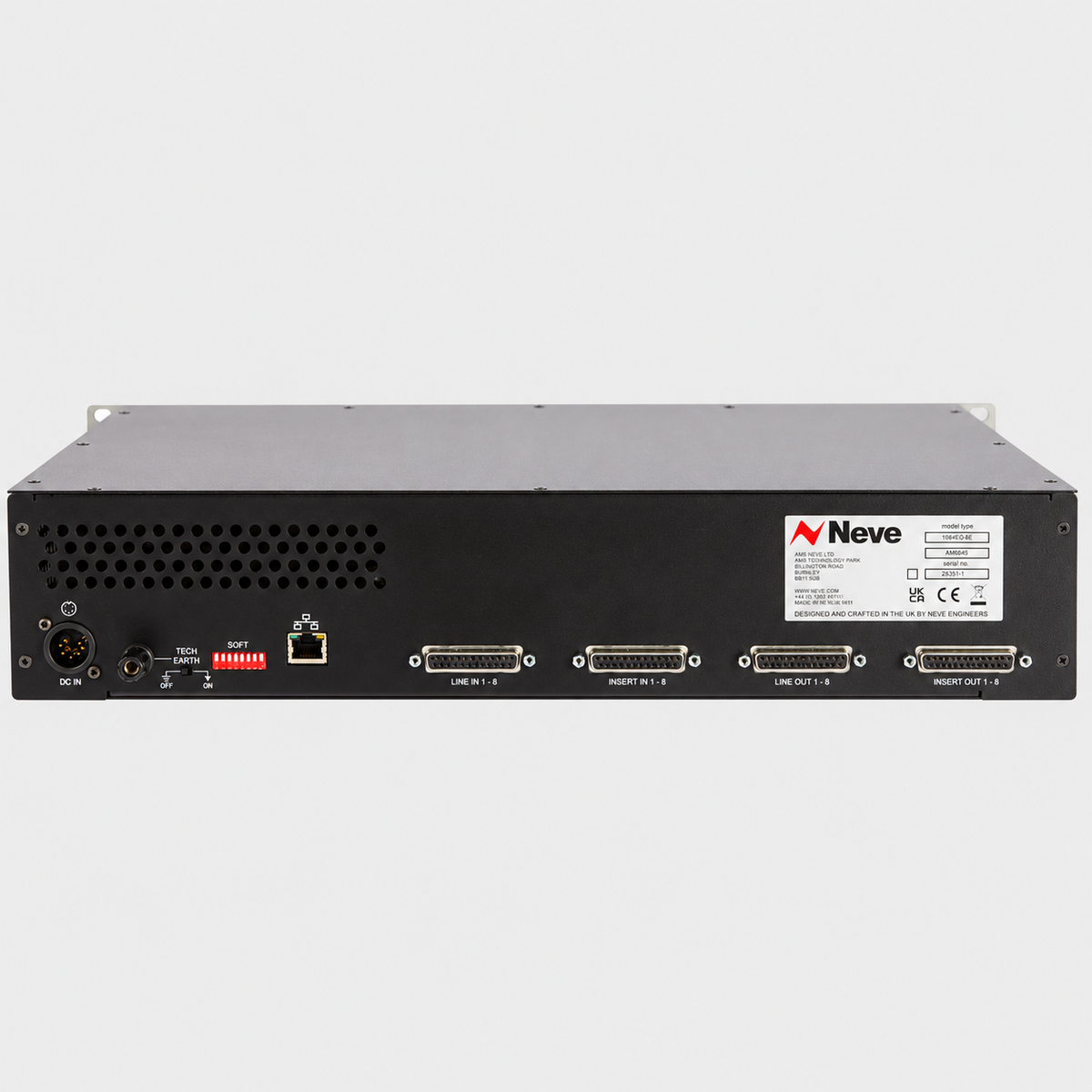
Elements is a standalone system that works with existing analogue consoles, audio interfaces and patch bays. Connect the analogue signal path through the D-sub audio I/O and use Ethernet for control communication. You can build it into an established outboard setup without making a console purchase part of the plan.
Every unit includes an intelligent insert matrix with insert send and return connections. Digital control of insert positioning gives you flexibility over where connected outboard sits in the signal path, helping the Elements processor become part of a wider analogue chain.
For a DAW-based setup, plan the analogue outputs and inputs needed on your audio interface, together with suitable D-sub cabling and the control connection. Ethernet carries the control communication; audio enters and leaves through the analogue connections.

START WITH EIGHT. BUILD FROM THERE.
A system that can grow
with your studio.
Start with the processing you need today. Add more channels of the same type as demand grows, or combine Elements 88R EQ, 88R Dynamics and 1084 EQ units to bring different tonal and dynamic tools into the same system. Each processor occupies 2U of a standard 19-inch rack.
If an 8424E becomes part of the studio later, Elements offers a route to integration and control from the console surface. Until then, the standalone plug-in and application workflow lets you use the hardware in your existing setup. The unit measures 483 mm wide, 89 mm high and 361 mm deep, making rack planning straightforward.
BEFORE YOU BUILD YOUR SYSTEM
A few useful details.
Do I need a Neve 8424E console?
No. Elements is designed to work independently with an appropriate audio interface, analogue console or patch bay. Integration with the 8424E is an additional option.
Is this a software emulation?
No. This is an eight-channel analogue hardware processor. The Element Control Plugin and Elements application control the real circuitry and provide the digital workflow.
Does Ethernet carry the audio?
Ethernet is used for control communication. The audio signal connects through the unit’s analogue D-sub I/O; a suitable analogue signal path is required.
NEVE ELEMENTS / 1084 EQ
Make it part of your sound.
Authentic Neve circuitry. Eight analogue channels. A workflow that brings your hardware into the session.
Speak to SX Pro about building an Elements system around your studio, your existing outboard and the way you like to work.