



Elysia
Elysia Channex | Studio


Omni Capital Finance Calculator
Choose options
Omni Capital Finance Calculator
Omni Capital Finance Calculator
Product overview
Analogue recording, tone shaping and monitoring—with complete recall
The Elysia Channex | Studio brings a microphone and instrument preamp, four-band dynamic EQ, compressor, limiter, analogue colour processing and a complete recording monitor section into one channel strip. Its strength is how those sections work together: you can capture a carefully shaped vocal, give a bass more density on the way in, or send an existing track back through the hardware during mixing, then save the setup for your next session.
The main processing path is analogue Class A, with digital control of the hardware. That gives you hands-on sound shaping alongside preset storage, remote operation and DAW recall. It is a single-channel recording and processing path, with stereo playback and effects connections serving the monitoring section. An audio interface provides the conversion into and out of your DAW.
A preamp for microphones, instruments and recorded tracks
The DC-coupled preamp offers gain from −10 dB to +64 dB, with separate microphone, line and front-panel high-impedance instrument inputs. Each input remembers its own gain setting. Switching from a vocal microphone to a bass or a line-level return therefore does not mean rebuilding your input gain from scratch.
A variable high-pass filter lets you remove unwanted low-frequency energy before the main processing, while polarity reversal helps when combining the recording with another microphone or DI signal. Switchable 48V phantom power supports microphones that require it. The illuminated input metering shows the level after the preamp, so you can establish headroom before deciding how much EQ, compression or colour to add.
For tracking, start with the microphone position and input gain, then bring in filtering only as far as the source needs. With acoustic guitar, for example, excessive low-cut can remove useful body along with rumble; listening in the arrangement gives you a better reference than choosing a frequency by habit.
Four-band EQ with both static and dynamic control
The equaliser combines low, low-mid, high-mid and high bands, with adjustable bandwidth on every band and a choice of bell or shelving response on the outer bands. Each band supports static boost or cut as well as an independently adjustable dynamic contribution. A fixed tonal adjustment can therefore remain in place while the dynamic processing responds around it.
This makes the EQ useful for problems that change during a performance. A singer may sound balanced for most of a phrase but become sharp on particular consonants; dynamic attenuation can address that region when it becomes prominent. A bass may need occasional control of a resonant note while retaining its normal weight. Dynamic boosts also open up creative options for bringing out selected parts of the spectrum as the signal changes.
The Shell LED displays show the static setting and the EQ activity together. You can see which band is doing the work while listening to the result, rather than assuming that a larger control movement necessarily produces a better recording.
Compression for the performance, limiting for the peaks
The dynamics section provides independently adjustable compressor and limiter behaviour. Threshold, release and make-up gain are readily accessible, with deeper settings for attack, ratio and sidechain filtering. The compressor has a soft-knee response suited to gradual level control; the limiter uses a harder characteristic and Auto Fast behaviour for short peaks. Their detectors operate in parallel, with the greater gain-reduction demand determining the attenuation.
That is useful when a vocal needs some overall levelling but occasionally produces a much louder accent. You can shape the general movement with the compressor and set the limiter to respond to those exceptional peaks. On bass or percussion, attack and release settings let you explore the relationship between the initial note and its sustain.
The Gain Reduction Limiter is a separate concept: it caps how much compression is applied. It does not set an absolute output ceiling. This gives you a way to establish a controlled amount of dynamics processing without allowing louder passages to trigger ever-deeper compression.
Sidechain options include high-pass, low-pass and a vocal-focused filter. These change what the detector responds to. For example, reducing the influence of bass in the detector can help stop a low-frequency burst from pulling down the whole signal.
Flavor: five ways to develop the sound
The Flavor section combines four analogue colour processes with a compressor macro. The colour stages can be used together, with individual intensity settings, so you can build a character rather than choose a single fixed voicing.
- Warm: combines slew-rate limiting and filtering for a smoother, more bass-focused balance, with less high-frequency emphasis.
- Saturation: introduces soft overdrive with predominantly odd harmonics, giving you a route towards a denser or more assertive texture.
- Harmonics: uses waveshaping to add predominantly even harmonics; stronger settings can emphasise transients.
- Sunrise: blends in an inductor-based filter for a presence lift.
- Density: changes several compressor parameters together, providing quick access to different compression characters.
For a vocal, try establishing the basic balance with EQ before adding a little harmonic texture or presence. For a DI instrument, explore a stronger colour setting, then reassess how the attack sits against the drums. The section bypass makes it straightforward to check whether the extra processing improves the part.
Change the processing order to suit the source
The equaliser, hardware insert, dynamics section and Flavor section can be rearranged from the hardware or control software. The preamp stays at the beginning and the output at the end. This lets you change the interaction between processors without repatching the internal chain.
Two useful starting points
EQ before dynamics: remove an excessive resonance or adjust the tonal balance before the compressor responds. A significant boost can also make the compressor react more strongly to that part of the sound.
Dynamics before EQ: establish the movement and sustain first, then shape the resulting tone. Moving Flavor earlier or later gives you another comparison: colour can influence what reaches the dynamics stage, or be added after it.
Integrate outboard—and capture a clean alternative
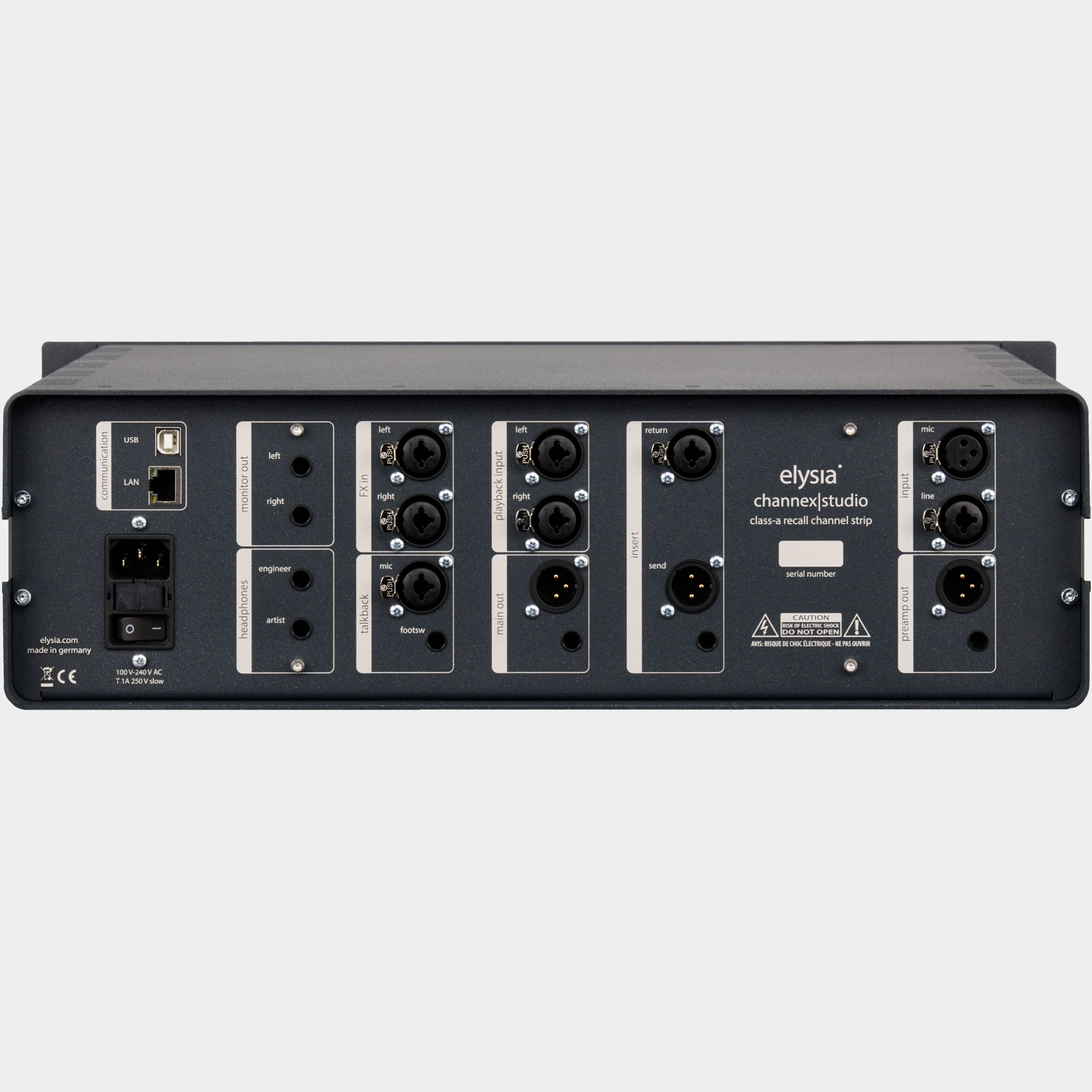
The balanced XLR insert send and return bring an external mono processor into the configurable chain. You could keep a favourite EQ or compressor connected and engage it only when required. Its position determines whether it receives an already shaped signal or feeds the Channex processing that follows.
A separate preamp direct output taps the signal after the preamp and high-pass filter. With a spare interface input, you can record this alongside the fully processed main output. That is particularly useful when you want to commit to a sound while keeping an alternative for later decisions. The insert send can also act as an additional line output at its chosen position in the chain.
Independent monitoring for the artist and engineer
Three independent monitor mixes serve the artist headphones, engineer headphones and monitor output. Each can balance the processed input against stereo playback, with effects added as needed. The direct monitoring path avoids a round trip through the DAW, allowing the performer to hear the source without the delay associated with software input monitoring.
This separation matters during a take. The artist may need a prominent vocal and a little ambience, while the engineer wants to hear the recording more critically against the backing track. Changing one balance does not require compromising the other.
The internal reverb is for the monitor mixes, so a singer can hear a more comfortable performance sound while you capture the main signal without that monitoring reverb. A stereo FX input accommodates external effects, and the internal reverb can be muted when you prefer an external return.
Dedicated headphone amplification, front and rear headphone connections, an external talkback microphone input and footswitch operation make the unit practical at the centre of a recording setup. Configurable record/playback mute states help you move between performing and reviewing takes.
Output control and soft clipping
The output section sets the level sent to the main analogue output, with metering and an optional soft clipper. Soft clipping rounds signal peaks and can help manage what reaches the next device, but the clipper threshold and output level still need to be matched to your converter's input headroom.
Use it deliberately: occasional peak control and audible saturation are different creative choices. Listen to sustained notes and vocal detail as well as watching the meters, and leave suitable recording headroom.
Recall on the hardware or inside your DAW
Up to 22 setups can be stored on the Channex itself. The control software adds preset management, A/B comparison and DAW session storage, with automation of supported parameters. USB or Ethernet connects the control system; audio continues through the analogue inputs and outputs.
For recurring vocal sessions, you can keep a useful starting setup for each microphone or performer. During mixing, session recall makes revisiting an earlier treatment much more practical. External equipment connected through the insert still needs its own settings restored.
The hardware's preset-loading behaviour also lets you recall processing first, with phantom power and monitoring settings recalled separately through its additional load step. That is a useful distinction when moving between different sources and listening arrangements.
A recording front end that stays useful during mixing
The Channex can serve as your main vocal or instrument recording chain, then return to work as a mono hardware insert for an existing track. Route an interface line output to its line input, record the main output back into the session, and use the processing order and recall system to compare approaches.
Its appeal is the combination of detailed analogue processing and the practical work around a session: input selection, alternative recording outputs, cue mixes, talkback and repeatable settings. You can use a small part of that system for a straightforward recording, or build a much more involved chain when the source calls for it.
Product information
Essential details
- Warranty
- 2 Years