

Elysia
Elysia Alpha Compressor


Omni Capital Finance Calculator
Choose options
Omni Capital Finance Calculator
Omni Capital Finance Calculator
Product overview
Mastering dynamics with control over tone, space and transient detail
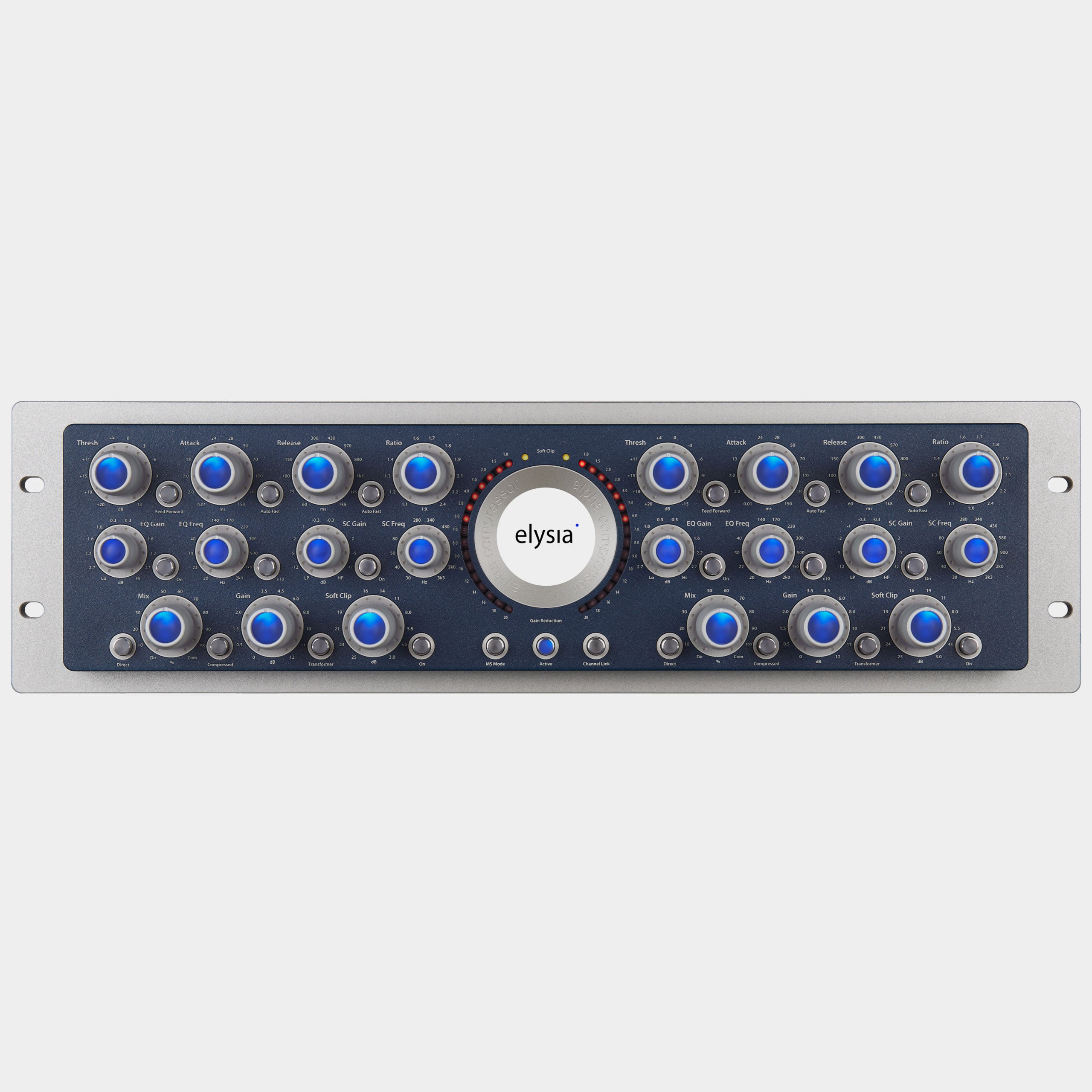
The Elysia Alpha Compressor is a two-channel analogue dynamics processor built for detailed work on stereo mixes and masters. Alongside compression, it provides Mid/Side operation, parallel blending, separate audio and sidechain filters, switchable transformers and soft clipping. These functions let you assess the dynamics, tonal balance and spatial presentation as parts of the same process.
Its discrete Class-A design provides the foundation, while the controls let you choose how audible the treatment should become. It can serve as a restrained mastering compressor, a more assertive mix-bus processor or a way to address the centre and surrounding stereo information differently.
Choose the compression behaviour
Feed Back and Feed Forward modes change where the detector takes its signal. Feed Back responds after the compression stage and offers a gentler operating characteristic; Feed Forward responds before it and makes stronger compression behaviours available.
Use the choice as an early part of setting the character. If a mix needs subtle continuity, begin with a modest ratio and restrained gain reduction. If you want more deliberate control over the rhythm or a stronger density change, compare the Feed Forward response at a similar output level.
Timing that can adapt to the material
Attack and release each have an Auto Fast option. These functions temporarily shorten the corresponding time when the signal requires a faster response, then return to the chosen setting. They help you explore a slower underlying movement while dealing with shorter events.
On a complete mix, listen to the vocal and sustained instruments as well as the drums. An attack setting that makes the snare exciting may affect the rest of the arrangement differently. Release deserves the same attention: the recovery between phrases can matter as much as the amount of reduction at a peak.
Stereo linking with independent finishing controls
Channel Link couples the compression so the left-side dynamics controls can govern both channels. The filters, Mix, Gain and limiter stages remain independently adjustable. This gives you coordinated dynamics without removing access to the individual finishing settings.
For straightforward stereo work, keep corresponding channel settings matched where you want a symmetrical result. For more specialised processing, the separate controls allow deliberate differences. The meters help you relate what each channel is doing to what you hear.
Mid/Side processing inside the unit
The internal matrix converts stereo into Mid and Side for processing, then decodes it back to left and right. The Mid contains the summed information, while the Side contains the difference. Central elements and wider ambience can therefore be treated differently.
You might use a small amount of control to settle a prominent central vocal while allowing more movement in the surrounding stereo field, or make different tonal adjustments to centre and ambience. These are context-dependent decisions: check the stereo image, mono compatibility and the relationship of the lead elements throughout.
Audio filtering and detector filtering serve different jobs
The audio filter is a tilt-style equaliser that changes the balance between lower and higher frequencies around a selected pivot. It is useful for a broad adjustment to the overall character when you do not need a full multi-band EQ.
The sidechain filter instead changes which frequencies influence compression. That lets you explore a detector response less dominated by the bass, or more focused on another region, without applying that same filter directly to the audible signal. Keeping those two purposes separate makes the controls much easier to use intentionally.
Build density through parallel compression
The Mix controls blend the direct and compressed paths. Direct and Compressed switches let you audition those components, helping you understand what the processing contributes before setting the final balance.
For a mix that loses too much impact with stronger compression, try blending the processed signal underneath the original. This can retain more of the initial dynamic structure while adding continuity. Recheck levels after changing the blend so the comparison remains about the sound, not simply the gain.
Transformers and soft clipping as separate choices
Switchable transformers offer another tonal option in the audio path. Compare them after establishing useful dynamics settings, and listen for how the character affects the entire mix rather than one attractive detail.
The Soft Clip limiters round short peaks and can help manage the level reaching an A/D converter. They need to be calibrated to the following device and used with appropriate headroom; they are not a substitute for checking the recorded peaks. Small amounts may complement compression, while stronger settings become a more audible texture.
Make changes that survive comparison
The Alpha's value is the ability to refine several connected aspects of a mix without losing sight of the whole. Work in small stages, use hardwire bypass as a reference and compare at similar perceived loudness. When revisiting a master, note both channels' settings, including the controls that remain independent when compression is linked.
Product information
Essential details
- Warranty
- 2 Years